


One of the topics discussed before the Singapore GP was William’s upgrade. Upgrades are the most important part of the Formula One teams’ strategy. They are meant to be done carefully and if done right can be rewarding. McLaren’s Miami upgrade proves that the team was never in the picture for winning a championship and is now leading the constructors championship. Lando Norris is on his way to taking the lead in the drivers’ championship.
If upgrades are not done correctly they can cause problems. Red Bull is a recent example. They dominated the past three seasons with upgrades turning their car into a “monster” according to lead driver Max Verstappen.
Like every team, Williams’ upgrade was supposed to be done in two instalments. The first upgrade was before the Dutch Grand Prix and the second Williams’ upgrade was due before the Singapore Grand Prix.
This article will discuss Williams’ upgrades and whether they impacted their performance.
Weight reduction Strategy
The main goal of the first instalment of Williams’ upgrade was to increase downforce. Williams started the season above the minimum weight limit (over 10kg). The gradual efforts to reduce the car’s weight have brought the weight to the 798kg limit with only very few additional weights remaining.
New bodywork was also part of the Williams’ upgrade agenda. This brought major visual change and reduced the weight to the desired limit.
Aerodynamics changes., Balance and Local Local downforce
To achieve a more favorable dynamic, cooling system and Inlet Design. Previous underbite lip conditioned air spillage and induced downforce. New ‘overbite’ prioritizes creating downforce on the front of the floor. Overbite creates pressure differences to apply downward force increasing front downforce.
To shift aerodynamic pressure forward towards the front excel load on the front edge of the floor was increased. Increasing the load on the back improves the balance.
In Williams’ Upgrade before Singapore Grandprix adjustments were made to rear and front wings. This will help to optimize balance.
How much impact did these upgrades make?
Now that we have discussed upgrades it is time to analyze how much impact either positive or negative these upgrades have made.
For a thorough analysis, it’s important to consider the stats of both drivers on a team as driver skill plays a significant role. Williams made the mid-season change in their driver’s lineup replacing Logan’s sergeant with Franco Colapinto. So we will only analyze Alex Albon’s performance to compare as he is the consistent driver before and after the upgrades.
The drivers’ position on the starting grid is an important factor in measuring the car driver’s skill so we will compare the average starting position on the grid before and after the upgrades.

The graph above clearly shows Alex’s average starting grid position. Another key indicator of the car’s effectiveness is its ability to score points. The graph below illustrates the rise in points scored following the Dutch Grand Prix.
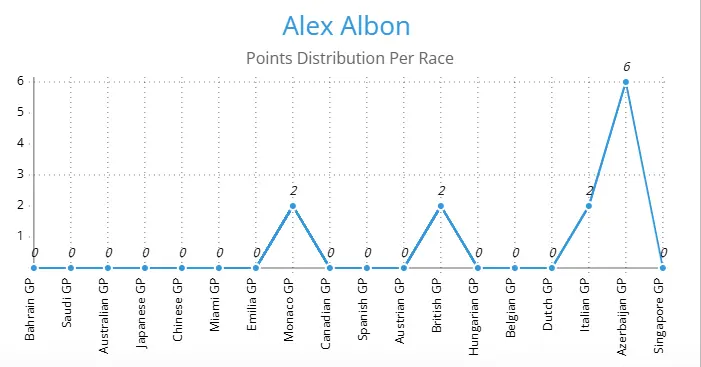
The other constituent that shows improvement is the average qualifying time. The average qualifying time three races before Willams’ upgrade and three races after the upgrade also show promising results.
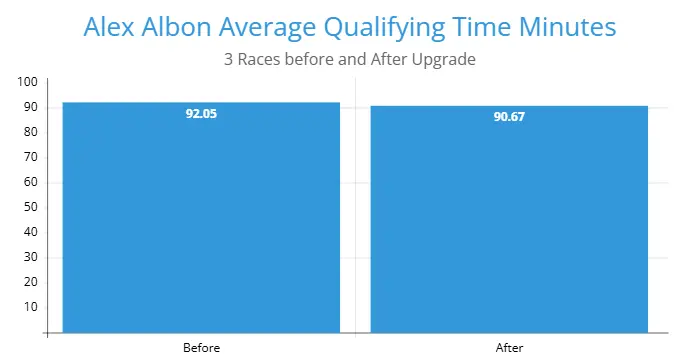
While most factors are promising a few components have declined after the upgrades. One such factor is the rise in Alex Albon’s average fastest lap time which is evidence of this decline.
Now saying that all the changes discussed above are solely attributed to the Williams’ upgrade would be wrong. Other factors such as weather, nature of tracks, and safety car factors are also involved so when studying these stats these factors should also be considered.